
Porcelain vs Composite Veneers — Which One Is Right for You?
This is the question most patients ask once they’ve decided veneers are worth exploring. Both options cover the front surface of your teeth. Both can fix chips, gaps, discolouration, and uneven edges. But they are different materials, different processes, different commitments, and different price points.
Here’s how they actually compare — and when each one makes more sense.
The quick comparison
| Porcelain | Composite | |
|---|---|---|
| Cost per tooth | $1,200–$2,000 | $200–$500 |
| Appointments | 2 (over ~2 weeks) | 1 (same day) |
| Lifespan | 10–20 years | 5–7 years |
| Stain resistance | Excellent | Moderate |
| Tooth preparation | Enamel removed (irreversible) | Minimal or none |
| Repairability | Must be replaced if chipped | Can be patched or reshaped |
| Appearance | Closest to natural enamel | Good, but less translucent |
Both have their place. The right choice depends on your situation, not on which one is “better” in the abstract.
How porcelain veneers work
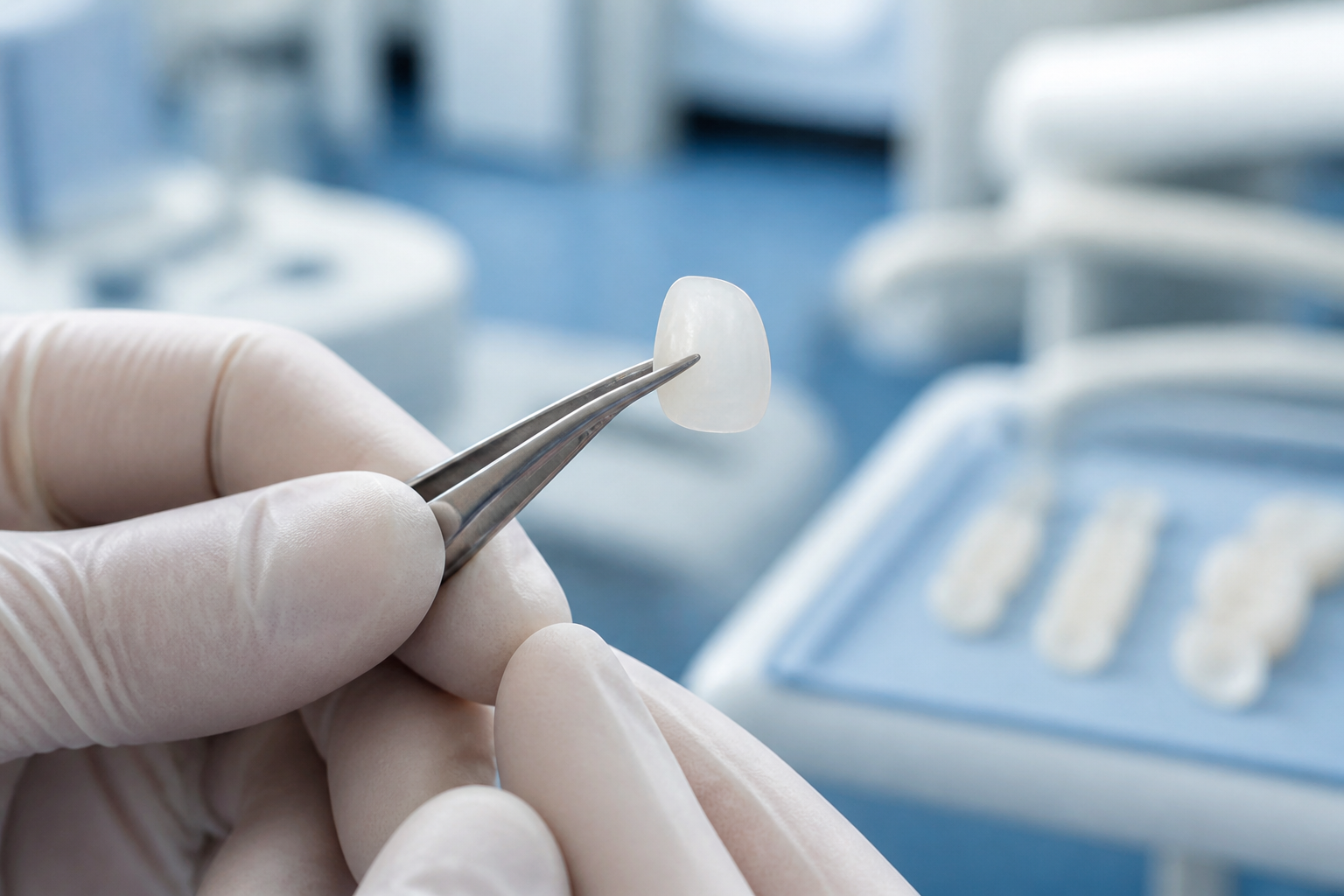
Each porcelain veneer is a thin ceramic shell, custom-made in a dental laboratory to match the shape and shade of your teeth. The process takes two appointments at our Parap clinic.
First appointment: Dr Pham prepares the teeth by removing a thin layer of enamel — usually 0.3 to 0.7 millimetres. This is necessary for the porcelain shell to sit flush with your natural tooth line. Detailed impressions are taken and sent to the lab, and temporary veneers are placed to protect your teeth while you wait.
Second appointment (about two weeks later): The finished porcelain veneers are tried in, adjusted for fit and bite, and permanently bonded.
The enamel removal is the key commitment. Once that layer is gone, the tooth will always need to be covered — by a veneer or a crown. This is irreversible, and it’s the main reason some patients hesitate.
What you get in return is a material that behaves remarkably like natural tooth enamel. Porcelain transmits light similarly to real enamel, resists coffee and red wine staining, and holds its shape for a decade or more with normal care.
How composite veneers work
Composite veneers are built directly on your teeth using tooth-coloured resin — the same material used in white fillings. Dr Pham layers the resin onto the tooth surface, sculpts it by hand, and cures it with a UV light, all in a single appointment.
No lab is involved. No temporaries. In most cases, no enamel removal is needed either — which means the process is reversible. If you decide five years from now that you want porcelain veneers instead, or if your teeth are fine without them, the composite can be removed without permanent changes to your natural teeth.
The trade-off is durability. Composite resin is softer than porcelain, so it wears faster, picks up staining more readily, and is more likely to chip from biting hard foods. Most composite veneers need refinishing or replacement within five to seven years.
When porcelain is the stronger choice
- Full smile makeover (6–10 teeth) — when you’re transforming your entire smile, the durability and stain resistance of porcelain justify the higher cost. Over 15+ years, the cost per year is often lower than replacing composite every five to seven years.
- Severe discolouration — tetracycline staining, fluorosis, or deep intrinsic staining that whitening can’t fix. Porcelain’s opacity masks underlying colour more completely.
- Worn or shortened front teeth — porcelain holds its edge and shape better over time, which matters when you’re restoring teeth that have been ground down.
- You want a set-and-forget result — porcelain requires less maintenance and fewer touch-ups.
When composite makes more sense
- One or two teeth — fixing a single chipped incisor or closing a small gap doesn’t warrant the cost or commitment of porcelain. Composite handles this in one visit for a fraction of the price.
- You’re under 25 — younger patients are still experiencing subtle changes in their bite and tooth position. Composite lets you improve your smile now without an irreversible commitment while things are still settling.
- You’re not sure — if you’ve never had cosmetic dental work and you want to see how veneers look and feel before committing to porcelain, composite is a low-risk trial run.
- Budget is a priority — composite veneers cost roughly a quarter to a third of porcelain per tooth. For patients who want a visible improvement now, composite delivers.
- You grind your teeth heavily — porcelain veneers can fracture under strong grinding forces. If bruxism is an issue that isn’t yet managed with a night guard, composite is easier and cheaper to repair.
What about appearance?
Porcelain has a slight edge in how it mimics natural tooth enamel — the way it catches and transmits light is closer to the real thing. In a full-arch makeover, this difference is visible.
For a single tooth or a couple of teeth, well-placed composite in the hands of an experienced dentist can be nearly indistinguishable from the surrounding natural teeth. The gap between the two materials has narrowed considerably with modern composite resins.
What matters more than the material is the skill of the person placing them. A well-done composite veneer will look better than a poorly done porcelain one.
Can you mix both?
Yes. Some patients choose porcelain for the most visible upper front teeth (the four or six that show when you smile) and composite for the teeth further back that are less prominent. This balances cost and aesthetics.
Dr Pham will discuss whether a combined approach makes sense for your specific case during your consultation.
Longevity and replacement
Porcelain veneers that are well cared for — regular brushing, flossing, no biting ice or bottle caps, wearing a night guard if you grind — routinely last 15 years, and many last 20 or more. When they do eventually fail, it’s usually a debond or a chip at the edge, and the tooth underneath is healthy.
Composite veneers typically need attention within five to seven years. Sometimes it’s a polish and minor reshaping. Sometimes the whole veneer is replaced. The advantage is that replacement is quick, affordable, and doesn’t involve further tooth preparation.
For a detailed breakdown of costs for both options, see our veneers pricing guide.
Not sure? Try it first — $199 Smile Simulation
If you’re torn between porcelain and composite — or not sure you want veneers at all — there’s a way to find out without committing to either.
Our $199 Smile Simulation starts with a digital scan of your teeth (no putty, no gagging), then a full digital redesign on screen. A physical trial smile is fabricated and fitted over your existing teeth, and you wear it out of the practice for a few days. Nothing is drilled. Nothing is permanent.
You come back, we take it off, and you tell us what you thought. The $199 is credited toward treatment if you go ahead. Any further treatment is quoted separately once you’ve seen the design.
It takes the guesswork out of the porcelain-vs-composite decision — because once you’ve seen the shape and proportions you actually want, the material conversation gets a lot simpler.
For full pricing, see our veneers cost guide.
Making the decision
There’s no universally correct answer. The right veneer type depends on how many teeth are involved, what you’re trying to fix, your budget, your age, and how long you want the result to last.
At Compass Dental Care, we offer both options and we’ll be direct about which one suits your situation. We don’t push porcelain when composite will do the job — and we don’t recommend composite when porcelain is genuinely the better long-term investment.
Want to compare options for your teeth?
Call us: (08) 8995 9530 Book a veneer consultation →


