
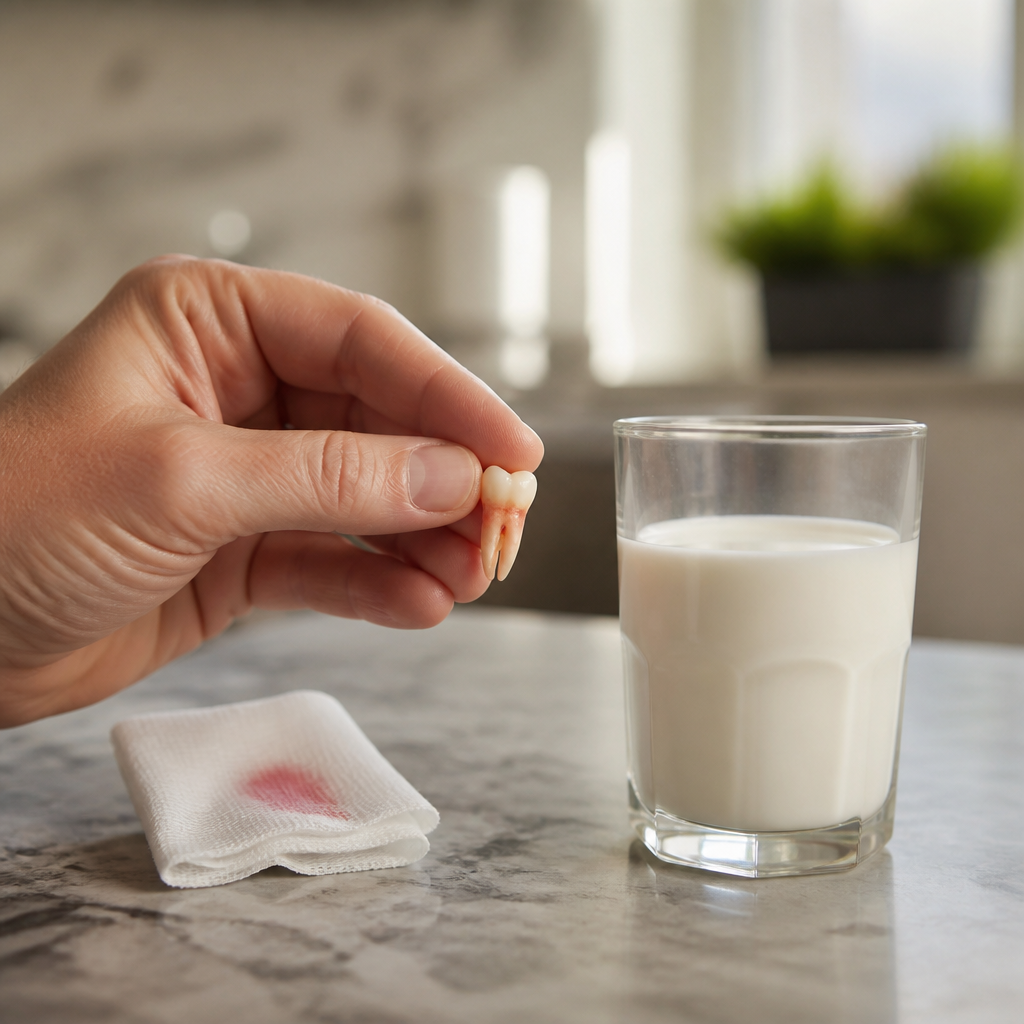
Knocked-Out Tooth First Aid — What to Do Right Now
A tooth that has been knocked completely out of its socket — known clinically as an avulsed tooth — is one of the most time-critical dental emergencies. But here is the reassuring news: with the right first aid and fast action, there is a very good chance the tooth can be saved and reimplanted successfully.
Every minute counts. The cells on the root surface of a knocked-out tooth begin to deteriorate almost immediately once they are exposed to air. The best outcomes occur when the tooth is reimplanted within 30 minutes. After 60 minutes, the chances drop considerably. After two hours, successful reimplantation becomes much less likely.
This guide gives you clear, step-by-step instructions so you know exactly what to do if you or someone around you has a tooth knocked out.
Step-by-Step First Aid for a Knocked-Out Tooth
Step 1: Stay Calm and Find the Tooth
Take a breath. Panic is natural, but calm, decisive action will give the best result. Find the tooth — check the ground, check inside the mouth, check clothing.
Step 2: Pick Up the Tooth by the Crown Only
The crown is the white, visible part of the tooth that you normally see above the gum line. The root is the pointed, yellowish part that was embedded in the jawbone.
Always handle the tooth by the crown. The root surface is covered in delicate cells called periodontal ligament cells that are essential for the tooth to reattach in the socket. Touching, rubbing, or scraping the root can destroy these cells and dramatically reduce the chances of successful reimplantation.
Step 3: Rinse Gently If the Tooth Is Dirty
If the tooth has landed on the ground and is visibly dirty, rinse it very briefly — no more than 10 seconds — under clean, gently running water. Hold it by the crown while you do this.
Do not:
- Scrub or brush the tooth
- Use soap, detergent, or disinfectant
- Wrap it in tissue or cloth to clean it
- Scrape any tissue or soft material off the root
Step 4: Try to Reimplant the Tooth
If the patient is conscious, cooperative, and old enough (generally over six years of age), try to place the tooth back into the socket. This is the single most effective thing you can do.
- Hold the tooth by the crown and identify the correct orientation — the smooth, curved side faces the lip, the flatter side faces the tongue.
- Gently push the tooth into the socket with steady finger pressure. It does not need to be perfectly aligned — your dentist will fine-tune the position.
- Once in place, have the patient bite down gently on a clean cloth, handkerchief, or folded gauze to hold the tooth in position.
- Get to the dentist as quickly as possible.
Do not force it. If the tooth will not go in easily, or if the patient is in too much pain, distressed, or unable to cooperate, do not persist. Move to Step 5 instead.
Step 5: If You Cannot Reimplant — Store the Tooth Properly
If reimplantation is not possible at the scene, the next priority is keeping the root cells alive by storing the tooth in an appropriate medium. The tooth must not dry out.
Best storage options (in order of preference):
- The patient’s own saliva. Have the patient spit into a small, clean container (a cup, a clean plastic bag, a water bottle lid) and place the tooth in the saliva. This is often the most practical option in an emergency.
- Cold milk. Regular cow’s milk (full cream is best, but any milk will do) has a pH and osmolality that is compatible with the root cells. This is the most commonly recommended option.
- Saline solution. If you have sterile saline (such as contact lens solution), this works well.
- Hanks’ Balanced Salt Solution. This is the gold standard for tooth storage, but it is rarely available outside a dental or medical setting. Some pharmacies stock tooth rescue kits containing this solution.
- Cling wrap. If none of the above options are available, wrapping the tooth in cling film can help retain moisture as a last resort.
Do NOT store the tooth in:
- Water (tap water is hypotonic and will cause the root cells to swell and die)
- Tissue or paper towel (draws moisture away from the tooth)
- Ice (too cold and can damage cells)
- Your pocket (the tooth will dry out and become contaminated)
Step 6: Get to the Dentist Immediately
Call Compass Dental and tell us you have a knocked-out tooth. We will prioritise your case and see you as an emergency.
Time matters:
- Within 30 minutes: Excellent chance of successful reimplantation
- 30 to 60 minutes: Good chance, provided the tooth has been stored properly
- 1 to 2 hours: Reduced chance, but still worth attempting
- Over 2 hours: Much lower chance of success, but your dentist will still assess whether reimplantation is viable
While you are on your way, keep the tooth in its storage medium and do not let it dry out.
What NOT to Do
In the stress of the moment, it is easy to make well-intentioned mistakes. Here are the most common ones to avoid:
- Do not handle the tooth by the root. This damages the cells needed for reattachment.
- Do not scrub, brush, or disinfect the tooth. You will destroy the delicate root surface cells.
- Do not let the tooth dry out. A dry tooth has almost no chance of successful reimplantation.
- Do not store the tooth in water. Plain water damages the root cells. Use milk or saliva instead.
- Do not wrap the tooth in tissue or a paper towel. These materials wick moisture away from the tooth.
- Do not try to reimplant a baby tooth. Pushing a baby tooth back into the socket can damage the developing permanent tooth underneath. Baby teeth that are knocked out are not reimplanted (more on this below).
- Do not ignore the injury. Even if you cannot find the tooth or it is too damaged to reimplant, you should still see a dentist for an assessment. There may be other injuries, fragments, or a partially embedded tooth that needs attention.
Baby Teeth vs Permanent Teeth — The Critical Difference
Baby Teeth (Primary Teeth)
If a child under the age of six or so has a baby tooth knocked out, do not try to reimplant it. Baby teeth are not reimplanted because:
- Forcing a tooth back into the socket can damage the permanent tooth bud developing underneath
- Baby teeth do not reimplant as reliably as permanent teeth
- The natural replacement — the permanent tooth — is already forming and will erupt in due course
What to do instead:
- Control any bleeding with gentle pressure using clean gauze.
- Apply a cold compress to the face to reduce swelling.
- Check that no tooth fragments are left in the mouth (these could be a choking hazard in young children).
- See a dentist for an assessment — even though the tooth will not be reimplanted, the dentist will check for other injuries and may place a space maintainer if the permanent tooth is not due to erupt for some time.
Permanent Teeth
For a knocked-out permanent tooth (which begin to appear from around age six), follow the full reimplantation first aid steps outlined above. Time is critical, and the sooner the tooth is back in the socket, the better.
If you are not sure whether the knocked-out tooth is a baby tooth or a permanent tooth, err on the side of caution. Store it in milk or saliva and bring it to the dentist. They will be able to identify it.
What Happens at the Dental Practice
When you arrive at Compass Dental with a knocked-out tooth, here is what you can expect:
Assessment
Dr Thien Pham will examine the tooth, the socket, and the surrounding area. An X-ray may be taken to check for fractures to the jawbone or root, and to assess the condition of the neighbouring teeth.
Reimplantation (If Not Already Done)
If the tooth has not been reimplanted at the scene, Dr Pham will clean the socket gently, position the tooth correctly, and push it back into place. Local anaesthetic will be used to ensure you are comfortable during this process.
Splinting
Once the tooth is in position, it will be splinted — attached to the neighbouring teeth with a flexible wire and composite resin. This holds the tooth stable while it heals and reattaches to the bone and gum tissue. The splint typically stays in place for two to four weeks.
Medication
You may be prescribed antibiotics to prevent infection and anti-tetanus treatment if indicated (particularly if the tooth was contaminated with soil). Pain relief recommendations will also be provided.
Follow-Up and Root Canal Treatment
In most cases, a reimplanted permanent tooth will need root canal treatment. This is because the blood supply to the pulp (the living tissue inside the tooth) is severed when the tooth is knocked out. Without root canal treatment, the pulp can become infected.
Root canal treatment is usually started one to two weeks after reimplantation, once the initial healing is underway. Dr Pham will monitor the tooth over the following weeks and months with clinical examinations and X-rays.
If Reimplantation Is Not Possible
If too much time has passed, the root is damaged, or the tooth has dried out, reimplantation may not be viable. In this case, your dentist will discuss replacement options with you, which may include:
- Dental implant — an artificial tooth root placed in the jawbone, topped with a crown. This is generally considered the best long-term replacement for a missing tooth.
- Dental bridge — a false tooth held in place by crowns on the neighbouring teeth.
- Removable partial denture — a removable replacement tooth. This may be used as a temporary solution while planning a more permanent option.
If the patient is a child or teenager whose jaw is still growing, an implant may not be placed immediately. Interim options such as a removable denture or orthodontic retainer with a replacement tooth can be used until growth is complete.
The Long-Term Outlook for a Reimplanted Tooth
The success of reimplantation depends on several factors:
- Time out of the socket. The shorter, the better.
- How the tooth was stored. Milk and saliva preserve root cells far better than water or dry storage.
- Whether the tooth was handled correctly. Minimal handling of the root gives the best results.
- The patient’s age. Children and teenagers tend to have better healing responses.
- The stage of root development. Teeth with open (immature) root tips in children sometimes regain their blood supply, a process called revascularisation.
With prompt treatment and appropriate follow-up care, many reimplanted teeth can last for years or even decades. However, some reimplanted teeth may eventually develop complications such as root resorption (where the body gradually breaks down the root) and may eventually need to be replaced.
Regular follow-up appointments are essential. Dr Pham will monitor your reimplanted tooth over time and intervene early if any problems develop.
Preventing Knocked-Out Teeth
While accidents happen, there are steps you can take to reduce the risk:
Wear a Mouthguard During Sport
If you or your child play any contact or collision sport — AFL, rugby, rugby league, basketball, hockey, martial arts, boxing, cricket, soccer — a properly fitted mouthguard is the most effective way to protect teeth from being knocked out. Custom mouthguards made by your dentist provide significantly better protection and comfort than the boil-and-bite varieties available from the chemist.
Childproof Your Environment
For young children, secure furniture that could topple, use safety gates near stairs, and supervise active play. Falls are the most common cause of dental trauma in toddlers and preschoolers.
Address Protruding Front Teeth
Teeth that protrude significantly (a large overjet) are at greater risk of trauma. Orthodontic treatment to bring protruding teeth into alignment can reduce this risk.
Be Mindful of High-Risk Activities
Trampolines, skateboards, scooters, bicycles, and playground equipment are common settings for dental injuries. Helmets with face guards (where appropriate) and supervised play can reduce the risk.
Frequently Asked Questions
Can you reimplant a tooth that has been out for several hours?
It is unlikely to succeed long-term, but your dentist may still attempt reimplantation depending on the circumstances. Even if the tooth does not survive permanently, it may be maintained for a period while you plan a replacement.
What if I swallowed the knocked-out tooth?
Do not panic. A swallowed tooth will usually pass through the digestive system without any problems. See your dentist for an assessment — there may be other injuries, and you will need to discuss replacement options.
Can a knocked-out tooth be put back in at the hospital?
The hospital emergency department may be able to reimplant a tooth, but dental practices are generally better equipped for this procedure and the follow-up care required. If you can get to a dentist within the critical window, go to the dentist. If you cannot, the hospital ED is a reasonable alternative.
Does it hurt to reimplant a tooth?
Your dentist will use local anaesthetic to numb the area before repositioning and splinting the tooth. You should not feel pain during the procedure. After the anaesthetic wears off, some discomfort and tenderness is normal and can be managed with over-the-counter pain relief. We also offer happy gas sedation if you are feeling anxious.
How long does the splint stay on?
Typically two to four weeks, depending on the type of injury. Your dentist will advise you on the exact timeframe and when to return for splint removal.
Act Fast — Call Compass Dental
If you or someone you are with has had a tooth knocked out, time is the most important factor. Follow the first aid steps above and call Compass Dental immediately. We prioritise dental trauma and will make room to see you as an emergency.
Dr Thien Pham and our team have been managing dental emergencies in Darwin for over 10 years. We are experienced in reimplantation and trauma management, and we will guide you through every step of the process.
Call us now or book an emergency appointment online.
If the patient has also sustained a head injury, loss of consciousness, or other significant injuries, call 000 or go to the emergency department first.


