
Impacted Wisdom Teeth — What Are They and Why Do They Matter?
Understanding Why Some Wisdom Teeth Get Stuck and What to Do About It
If your dentist has told you that your wisdom teeth are “impacted,” you might be wondering what that actually means — and whether it is something you need to worry about. The short answer is: impaction is common, it does not always cause immediate symptoms, but it can lead to serious problems if left unmonitored or untreated.
At Compass Dental in Darwin, impacted wisdom teeth are one of the most frequent issues we diagnose and treat. In this article, we explain exactly what impaction is, the different types, the symptoms to look out for, and what treatment involves.
What Does “Impacted” Actually Mean?
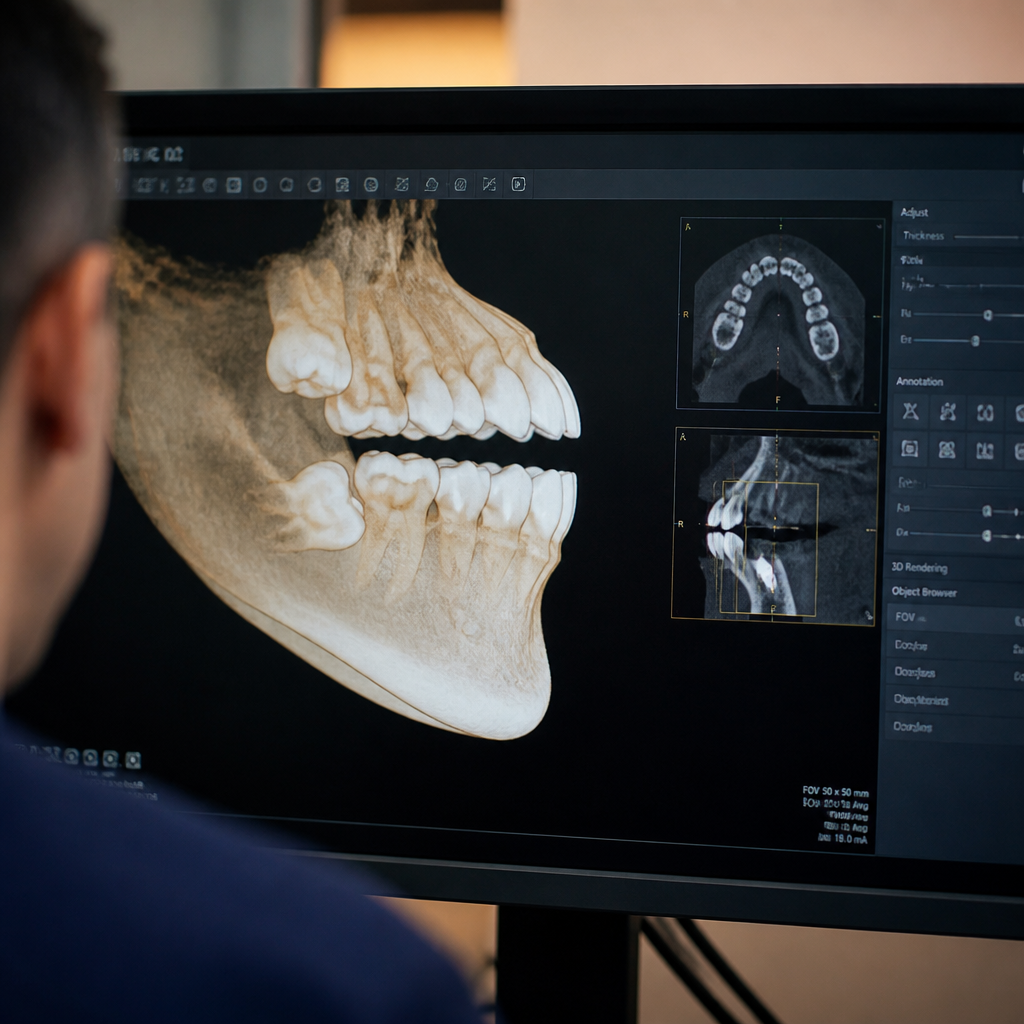
A wisdom tooth is considered impacted when it cannot fully emerge through the gum into its normal position — usually because there is not enough room in the jaw.
- Partially impacted — the tooth has partially broken through the gum. This is often the most problematic scenario, because the partial opening creates a pocket where bacteria and food become trapped.
- Fully impacted — the tooth remains completely beneath the gum line. It may not cause symptoms immediately, but can still develop problems over time.
Impaction is extremely common — studies suggest that up to 70 to 80 per cent of adults have at least one impacted wisdom tooth. It is simply a consequence of modern jaw size being too small for the full complement of teeth.
Types of Impaction
Dentists classify impacted wisdom teeth according to the direction the tooth is angled and how deeply it is buried. Understanding the type of impaction helps your dentist plan the most appropriate treatment.
Mesial (Angled Forward)
The most common type. The wisdom tooth is angled forward, pushing towards the second molar. Mesial impactions often cause pressure on the neighbouring tooth and can lead to decay on its back surface.
Distal (Angled Backward)
The tooth is angled backwards, towards the back of the jaw. Less common than mesial impactions and can sometimes be more difficult to access for removal.
Horizontal (Lying on Its Side)
The wisdom tooth is lying on its side, parallel to the jawbone, and may be pressing into the roots of the second molar. Horizontal impactions typically require the tooth to be sectioned (divided into pieces) for removal.
Vertical (Straight Up but Stuck)
The tooth is oriented correctly but remains trapped because there is not enough room to erupt fully. Vertical impactions may eventually come through on their own, but often they remain stuck.
Soft Tissue vs Bony Impaction
In addition to the angle of the tooth, dentists also consider how deeply it is buried:
- Soft tissue impaction: The tooth has emerged from the jawbone but remains covered by gum tissue. These are generally less complex to remove.
- Partial bony impaction: The tooth is partially encased in bone. A portion of the crown is covered by bone while the rest may be under gum tissue only.
- Full bony impaction: The tooth is completely encased within the jawbone. These are the most complex to remove and typically require surgical extraction with bone removal.
Symptoms of Impacted Wisdom Teeth
Impacted wisdom teeth do not always produce obvious symptoms. Some patients only discover them on a routine X-ray. Others experience clear and sometimes urgent symptoms.
Common Symptoms
- Pain at the back of the jaw — ranging from a dull ache to sharp, throbbing pain, often worse when chewing
- Swollen, red, or bleeding gums — particularly around a partially erupted tooth
- Bad taste or bad breath — a hallmark sign of pericoronitis (infection of the gum around the wisdom tooth)
- Jaw stiffness — difficulty opening the mouth fully
- Swelling in the cheek or jaw — indicating significant inflammation or infection
- Earache or headache — referred pain from impacted lower wisdom teeth
- Difficulty or pain when swallowing — where infection spreads to throat tissues
When There Are No Symptoms
Just because an impacted wisdom tooth is not causing pain does not mean it is harmless. Problems can develop silently:
- Decay on the neighbouring tooth — a mesially angled wisdom tooth can press against the second molar and create an area that is impossible to clean. Decay develops on the contact surface without any symptoms until it becomes advanced.
- Cyst formation — the sac of tissue that surrounds a developing tooth can fill with fluid, forming a dentigerous cyst. These cysts enlarge slowly and can hollow out bone.
- Root resorption — the pressure from an impacted tooth can gradually eat away at the roots of the adjacent molar.
This is why regular dental check-ups and X-rays are important, even if you are not experiencing any pain.
How Are Impacted Wisdom Teeth Diagnosed?
Diagnosis involves two key steps:
Clinical Examination
Your dentist will examine the back of your mouth looking for signs of partial eruption, gum inflammation, swelling, and tenderness. They will also check the second molars for any signs of damage.
Imaging
- OPG (orthopantomogram): The standard panoramic X-ray showing the position, angle, and depth of all four wisdom teeth.
- CBCT (cone beam CT) scan: For complex cases where the wisdom tooth appears close to the inferior alveolar nerve. This three-dimensional scan helps your dentist plan a safe extraction.
Based on the examination and imaging, your dentist will explain the type and severity of impaction, whether damage to adjacent teeth has occurred, and whether removal is recommended now or monitoring is reasonable.
Risks of Leaving Impacted Wisdom Teeth
Not every impacted wisdom tooth needs to come out immediately. Your dentist may recommend monitoring in some cases — for example, if a tooth is fully impacted, deeply buried, and not causing any problems.
However, the risks of leaving a problematic impacted wisdom tooth include:
Recurrent Infection (Pericoronitis)
Partially impacted teeth are prone to repeated infection. Each episode can be more severe than the last, damaging surrounding tissue and bone.
Decay and Damage to Adjacent Teeth
A perfectly healthy second molar can develop decay or root damage from an impacted wisdom tooth pressing against it. In severe cases, the second molar may also need extraction.
Cyst or Tumour Development
While rare, cysts associated with impacted wisdom teeth can grow significantly if untreated, destroying bone and affecting nearby nerves.
Increased Surgical Complexity with Age
Wisdom teeth become more difficult to remove with age as roots lengthen, bone becomes denser, and recovery takes longer. A straightforward extraction at 20 can become a more involved procedure at 40.
Treatment: How Impacted Wisdom Teeth Are Removed
The treatment for a problematic impacted wisdom tooth is extraction. The specific approach depends on the type and depth of impaction.
The Procedure
Most impacted wisdom teeth at Compass Dental are removed under local anaesthetic combined with happy gas (nitrous oxide). The local anaesthetic ensures the area is completely numb, while happy gas keeps you calm and relaxed. You remain conscious throughout and can communicate with the dental team.
For a surgical extraction of an impacted tooth, your dentist will typically:
- Make a small incision in the gum to expose the tooth and bone
- Remove any bone that is blocking access to the tooth
- Section the tooth into smaller pieces if necessary — this is common and makes removal easier and less invasive
- Remove the tooth or tooth sections
- Clean the surgical site thoroughly
- Place dissolvable stitches to close the gum
The procedure is well-practised and routine. For exceptional cases, alternative sedation approaches may be discussed, but the vast majority of impacted wisdom teeth are comfortably managed with local anaesthetic and happy gas.
Recovery
Recovery is generally similar to any wisdom tooth extraction, though surgical sites may take slightly longer to heal. Most patients are back to normal within a week and fully healed within two to four weeks.
When Should You Have Impacted Wisdom Teeth Assessed?
If you are experiencing any symptoms — pain, swelling, a bad taste, jaw stiffness — book an appointment to have your wisdom teeth assessed. At Compass Dental, we can often accommodate urgent appointments within 24 to 48 hours when symptoms are concerning.
Even if you are not experiencing symptoms, we recommend having your wisdom teeth assessed as part of your regular dental check-ups, especially if you are in the 17 to 25 age range when these teeth typically develop.
Compass Dental has been serving Darwin and the wider Northern Territory for over 10 years. We regularly see patients who have travelled from remote communities across the Territory for wisdom teeth treatment. If you need advice about your wisdom teeth, we are here to help — wherever you are based.


