
Implants vs Bridges vs Dentures — Which Tooth Replacement Is Right for You?
If you have lost a tooth — or several teeth — you have three main replacement options: dental implants, bridges, and dentures. Each has its place, and the right choice depends on your situation, your priorities, and your budget.
This guide compares all three honestly, including the trade-offs that dental websites often gloss over.
Quick Comparison
| Factor | Implant | Bridge | Denture |
|---|---|---|---|
| Looks like a natural tooth | Yes | Yes | Partial — depends on fit |
| Chewing ability | 90-100% | 80-90% | 20-40% |
| Affects adjacent teeth | No | Yes (files down 2 teeth) | Clasps may stress teeth |
| Preserves jawbone | Yes | No | No |
| Lifespan | 20+ years (often lifetime) | 10-15 years | 5-10 years |
| Removable | No (fixed) | No (fixed) | Yes |
| Cleaning | Normal brushing/flossing | Threaders needed under bridge | Remove daily to clean |
| Surgery required | Yes (minor) | No | No |
| Timeline | 4-8 months | 2-3 weeks | 2-4 weeks |
| Cost (single tooth) | From $6,000 ($6,000-8,500) | $3,000-5,000 | $500-1,500 |
| Cost (20-year period) | From $6,000 ($6,000-8,500) | $6,000-10,000 (1-2 replacements) | $2,000-6,000 (relines + replacements) |
Dental Implants — The Gold Standard
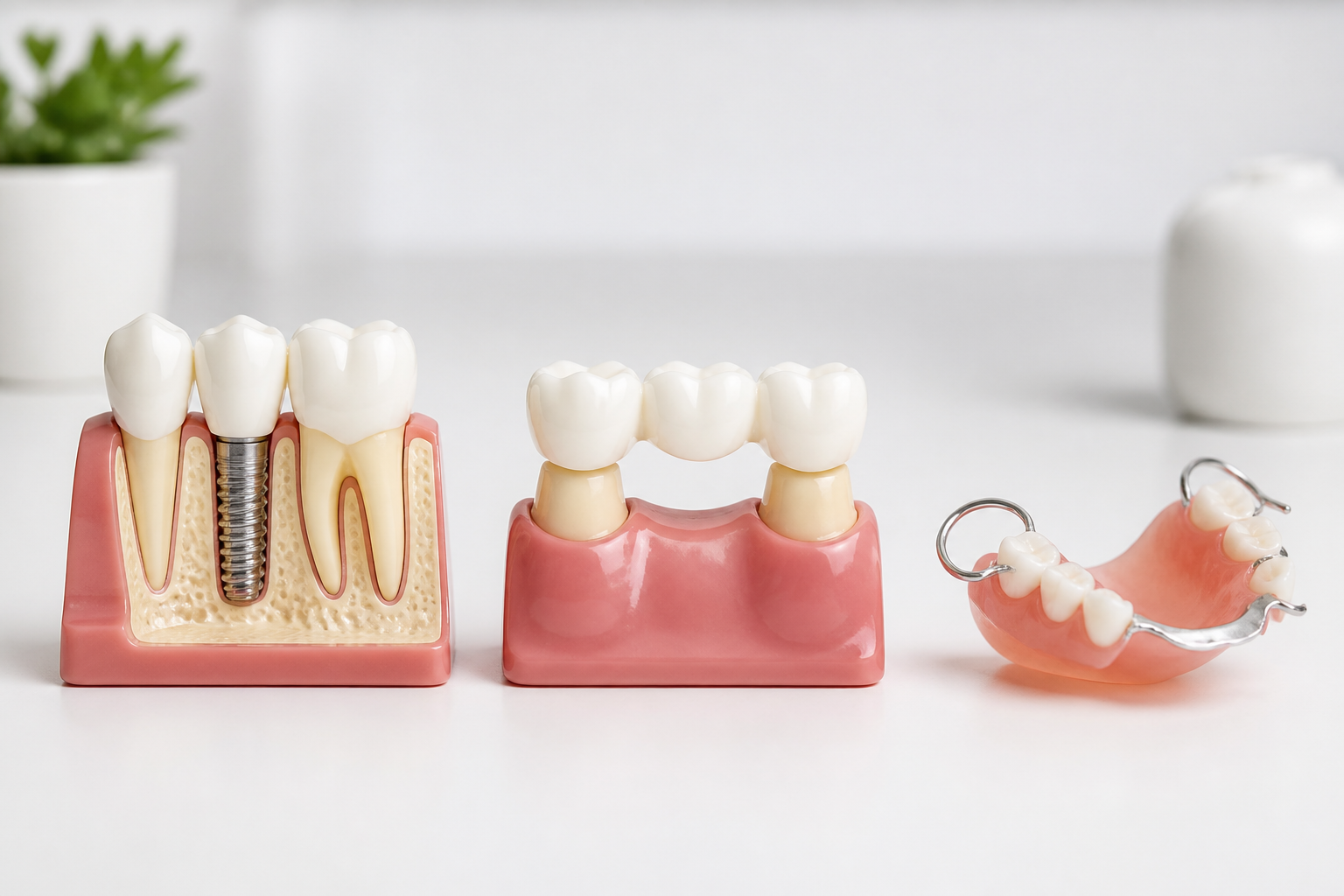
An implant replaces the root of a missing tooth with a titanium post, topped with a custom crown. It is the closest thing to a natural tooth.
Best for:
- Single missing teeth (especially if adjacent teeth are healthy)
- Multiple missing teeth (implant-supported bridge)
- Patients who want a permanent, low-maintenance solution
- Patients with loose dentures who want stability
Not ideal for:
- Patients who cannot undergo minor surgery (severe medical conditions)
- Insufficient jawbone without willingness to do bone grafting
- Tight budget where upfront cost is the primary concern
- Patients who need teeth immediately (healing takes 3-6 months)
The honest trade-off: Higher upfront cost and longer treatment time, but lower lifetime cost and superior long-term outcome.
Dental Bridges — Fixed Without Surgery
A bridge literally bridges the gap left by a missing tooth. Two crowns are placed on the teeth either side of the gap (abutment teeth), with a false tooth (pontic) suspended between them. The whole unit is cemented in place.
Best for:
- Single missing teeth where adjacent teeth already have crowns or large fillings
- Patients who want a fixed (non-removable) solution without surgery
- Faster treatment timeline needed
Not ideal for:
- Adjacent teeth that are healthy and untouched — a bridge requires filing them down
- Long spans of multiple missing teeth (bridges become less stable over longer gaps)
- Patients concerned about long-term bone loss (bridges do not stimulate bone)
The honest trade-off: Faster and cheaper than an implant initially, but sacrifices two healthy teeth to replace one, and will likely need replacing at least once in your lifetime.
Dentures — Removable and Accessible
Dentures are removable prosthetics that replace missing teeth. Partial dentures replace some teeth (held in place by clasps on remaining teeth), while full dentures replace all teeth in an arch.
Best for:
- Multiple missing teeth where implants or bridges are not practical
- Budget-conscious patients who need a functional solution now
- Temporary solution while planning implants
- Patients not suitable for surgery
Not ideal for:
- Patients who want something that feels natural — dentures sit on the gum and can feel bulky
- Active lifestyles — dentures can slip during eating, speaking, or physical activity
- Long-term bone preservation — bone loss accelerates under dentures
The honest trade-off: Most affordable and quickest to make, but least functional and least durable. Many long-term denture wearers eventually explore implant-supported options for improved stability.
Making the Decision
Ask yourself these questions:
- Are the teeth next to the gap healthy? If yes, avoid a bridge — an implant preserves them.
- Is long-term cost or upfront cost more important? Implants cost more upfront but less over 20 years.
- How important is chewing ability? If you want to eat everything normally, implants are the clear winner.
- Are you comfortable with minor surgery? If not, a bridge or denture avoids it.
- How many teeth are missing? Single tooth = implant or bridge. Multiple teeth = implants, implant-supported denture, or removable denture depending on budget.
Our Recommendation
We offer all three options at Compass Dental and will always present them honestly. In most situations, if a patient’s health and budget allow it, we recommend implants because they preserve bone, protect adjacent teeth, and provide the best long-term outcome.
But the best option is the one that works for your situation. We will explain the pros and cons of each option for your specific case and help you make an informed decision — no pressure.
Call us: (08) 8995 9530 Book a consultation →


