
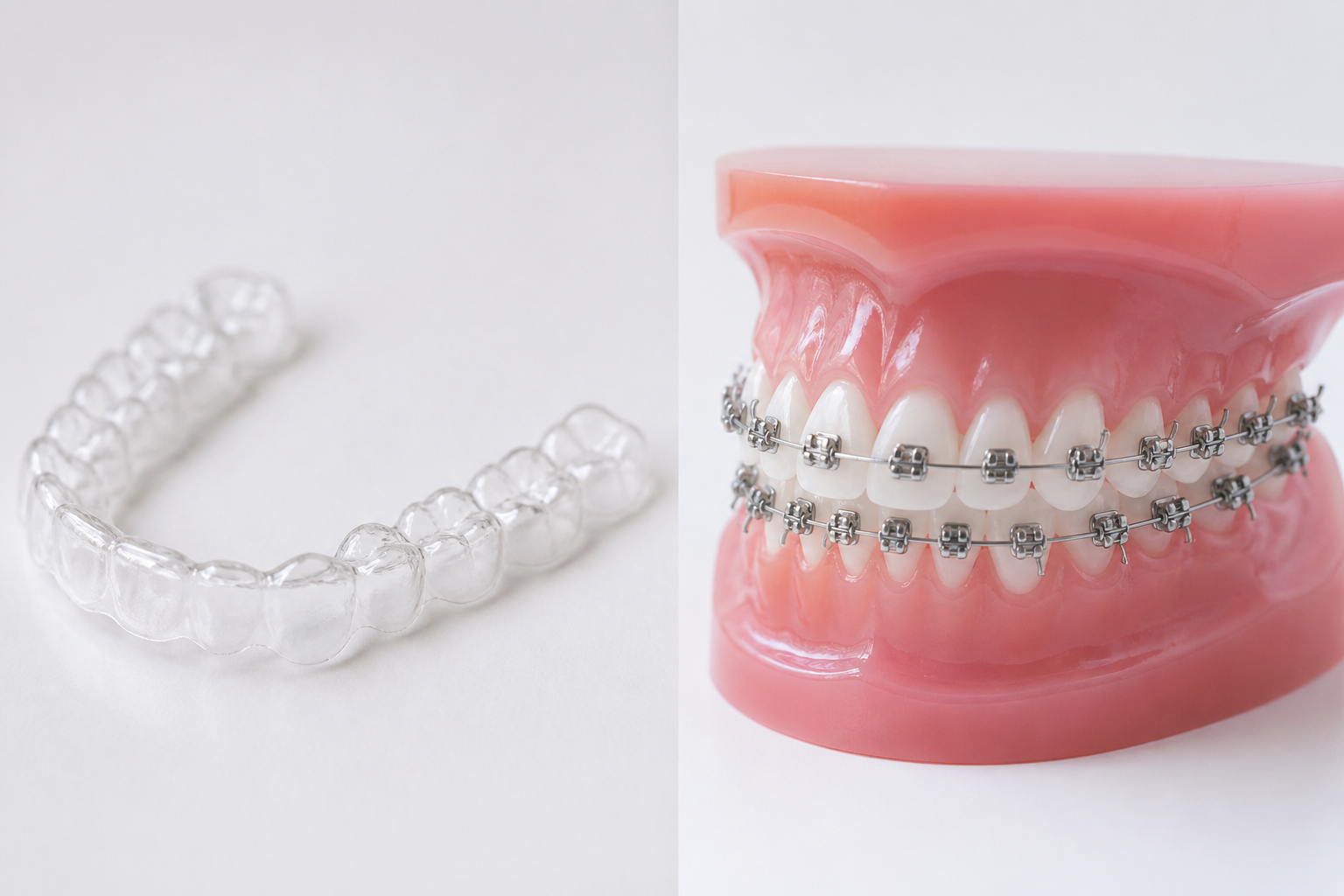
Clear Aligners vs Braces for Adults — Which Should You Choose?
If you are an adult considering straightening your teeth, you have likely asked this question. Both options work. Both produce excellent results. But they suit different situations, lifestyles, and personalities.
Here is an honest comparison to help you decide.
Side-by-Side Comparison
| Factor | Clear Aligners | Fixed Braces |
|---|---|---|
| Visibility | Nearly invisible | Visible (metal) or semi-visible (ceramic) |
| Removable | Yes — take out to eat and brush | No — fixed for the entire treatment |
| Comfort | Smooth plastic, no sharp edges | Brackets and wires can irritate cheeks initially |
| Compliance needed | High — must wear 20-22 hours/day | None — always working |
| Diet restrictions | None — remove to eat anything | Yes — no hard, sticky, or chewy foods |
| Brushing/flossing | Normal — remove aligners to clean | More difficult — needs special tools |
| Best for | Mild to moderate cases | All cases, including complex |
| Treatment time | 6-18 months (mild-moderate) | 12-24 months (any complexity) |
| Cost | $4,000-8,000 | $5,000-9,000 |
| Appointments | Every 6-8 weeks | Every 4-6 weeks |
When Clear Aligners Are the Better Choice
- Your case is mild to moderate — spacing, mild crowding, minor alignment issues
- Appearance matters to you — professional settings, social situations, dating
- You are disciplined — you will genuinely wear them 20-22 hours per day without reminders
- You want flexibility — the ability to remove for important events, meals, and cleaning
- You have good oral hygiene — aligners require clean teeth before reinserting
When Fixed Braces Are the Better Choice
- Your case is complex — significant crowding, major bite correction, rotated teeth
- You know you will not be compliant — if there is any chance you will “forget” to wear aligners, braces remove that variable entirely
- You want the most predictable outcome — for complex cases, braces give the orthodontist more precise control
- Cost is a primary concern — braces can sometimes be slightly more affordable for equivalent treatment
- You are a teenager — compliance with aligners is often inconsistent in younger patients
The Compliance Question
This is the most important factor and the one most people underestimate. Clear aligners only work if you wear them. Every hour they are out of your mouth is an hour your teeth are not moving — or worse, moving back.
Be honest with yourself:
- Do you lose things regularly? (Aligner trays get left in restaurant napkins)
- Will you take them out “for just one drink” and then forget for hours?
- Do you snack frequently throughout the day? (Each snack means removing, eating, brushing, reinserting)
- Are you prone to skipping routines when tired or busy?
If you answered yes to several of these, braces may be the better choice — not because they are better, but because they work regardless of your habits.
A Common Middle Ground
Some patients start with a brief phase of fixed braces (3 to 6 months) to handle the heavy lifting (derotating teeth, correcting bite), then switch to aligners for the finishing refinement. This gives the effectiveness of braces with the cosmetic benefit of aligners for the visible final phase.
We will recommend this approach if it suits your case.
What About “Mail-Order” Aligners?
Companies that sell aligners directly to consumers (without in-person dental supervision) have become popular. We do not recommend them.
Why:
- No comprehensive dental examination before treatment — cavities, gum disease, and other issues can worsen during unsupervised orthodontic treatment
- No in-person monitoring — problems are caught later and are harder to fix
- Limited ability to handle mid-treatment complications
- No X-rays taken before treatment — root and bone health are unknown
- Results are often less predictable
Orthodontic treatment moves teeth through bone. This should be supervised by a dentist who has examined you in person, taken X-rays, and can monitor your progress at regular appointments.
Frequently Asked Questions
Can aligners fix an overbite?
Mild to moderate overbites can often be treated with aligners. Severe overbites or complex bite problems typically need fixed braces for more precise control. We will assess your bite at your consultation and recommend the most effective option.
Will people notice my aligners?
Most people will not notice unless they are looking closely. The trays are clear and fit snugly over your teeth. Some patients wear them through entire social events without anyone noticing. The small tooth-coloured attachments (if needed) are also discreet.
Can I play sport with braces or aligners?
With braces, you should wear a mouthguard for contact sports (we can make one that fits over your brackets). With aligners, remove them and wear a standard mouthguard during sport, then reinsert the aligners after.
What happens if I stop wearing my aligners for a few days?
Your teeth will begin to shift back. If you resume wearing, the aligners may feel tight or not fit properly. Contact us — we may need to adjust your treatment plan. Extended breaks can require starting a new set of aligners, adding time and cost.
Not sure which option is right for you? Book a consultation and we will assess your case and recommend the best approach.
Call us: (08) 8995 9530 Book online →


