
Can You Keep Your Wisdom Teeth? When Removal Isn’t Necessary
Not Everyone Needs Their Wisdom Teeth Out — Here’s How to Know
There is a common belief that everyone needs to have their wisdom teeth removed sooner or later. It is one of the most frequent assumptions we encounter at Compass Dental, and while it is true that many people do need their wisdom teeth extracted, it is not a universal rule.
Some people keep their wisdom teeth for their entire lives without any problems. The key is knowing when removal is genuinely necessary, when it is not, and how to monitor the situation if you fall somewhere in between.
Dr Thien Pham and our team at Compass Dental have been helping Darwin patients make informed decisions about their wisdom teeth for over 10 years. Our philosophy is straightforward: we recommend extraction when there is a clear clinical reason to do so, and we recommend monitoring when the teeth are healthy, functional and not causing trouble.
This article will help you understand where you stand.
When Wisdom Teeth Can Stay
Let us start with the good news. Your wisdom teeth do not automatically need to come out simply because they exist. In fact, if the following conditions are met, there may be no reason to remove them at all.
1. They Have Fully Erupted
Wisdom teeth that have come through the gum completely — just like your other molars — are far less likely to cause problems than teeth that are partially erupted or impacted. A fully erupted wisdom tooth sits at the gum line with no flap of tissue covering it, which means there is no pocket for bacteria to accumulate.
2. They Are Properly Aligned
Healthy wisdom teeth grow in the correct orientation — straight up and down, aligned with the rest of your teeth. They are not tilted, angled sideways, or pushing against the neighbouring second molar. Properly aligned wisdom teeth function like any other tooth and contribute to chewing.
3. You Can Clean Them Effectively
This is a crucial factor. Even fully erupted, well-aligned wisdom teeth can become problematic if you cannot reach them properly with your toothbrush and floss. Because they sit at the very back of the mouth, cleaning them requires a deliberate effort.
If you can brush all surfaces of your wisdom teeth and floss between them and the adjacent teeth — and your dentist confirms there is no build-up of plaque or early signs of decay — then you are managing them well.
4. They Are Not Causing Symptoms
Healthy wisdom teeth do not cause pain, swelling, gum irritation or any other symptoms. If your wisdom teeth have been present for years and have never given you trouble, that is a positive sign.
5. They Are Not Affecting Adjacent Teeth
Your dentist will check that the wisdom teeth are not pressing against or damaging the second molars. Crowding, root resorption (where the wisdom tooth gradually wears away the root of the neighbouring tooth) and decay on the adjacent tooth are all signs that removal should be considered.
6. X-rays Show No Underlying Problems
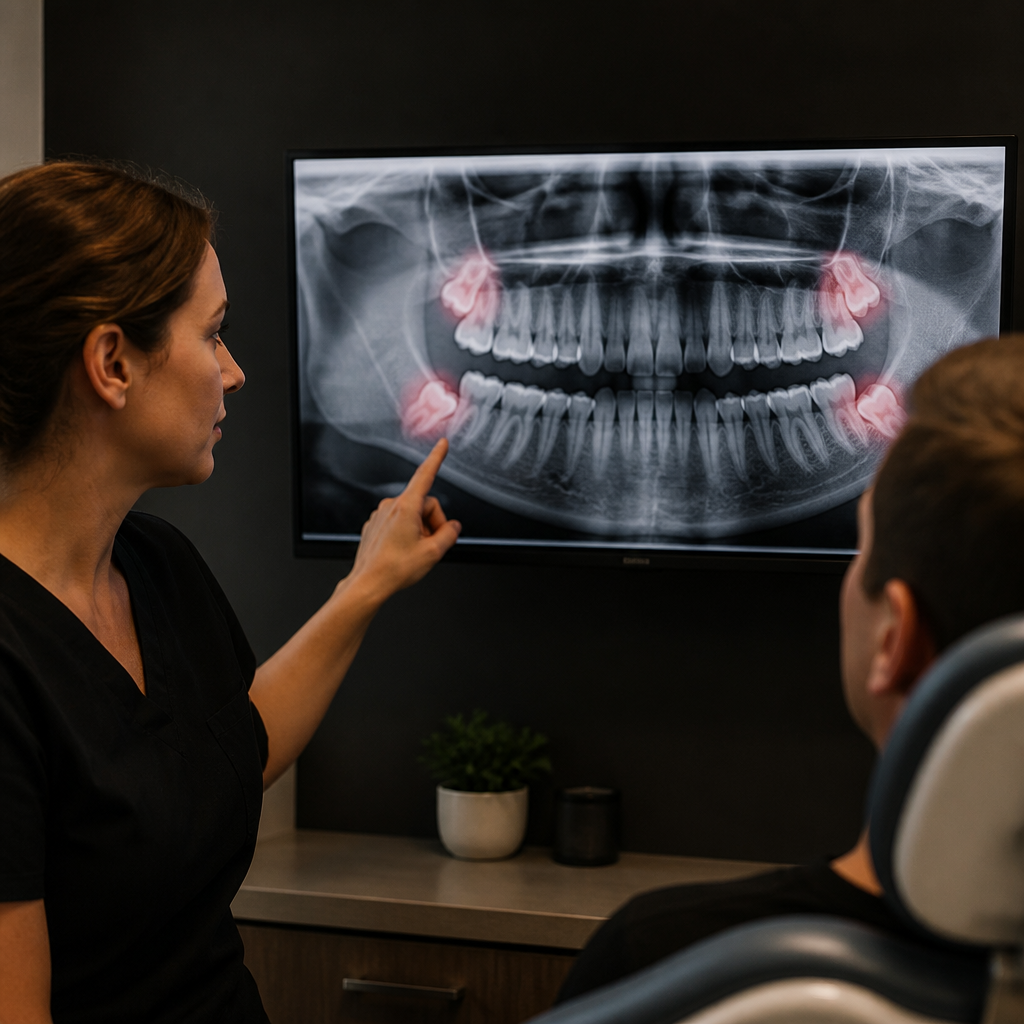
Even wisdom teeth that look fine on the surface can harbour issues beneath the gum line. Regular X-rays — particularly an OPG (panoramic X-ray) — allow your dentist to check for cysts, tumours, bone loss, hidden decay and other problems that are not visible during a standard clinical examination.
When Removal Is Recommended
While some wisdom teeth can stay, many cannot — and there are clear clinical situations where extraction is the right course of action.
Impacted Wisdom Teeth
An impacted wisdom tooth is one that does not have enough room to emerge normally. It may be partially erupted (only part of the crown is visible through the gum), completely buried beneath the gum, or trapped within the jawbone.
Impacted wisdom teeth are the most common reason for extraction. They can lead to:
- Pericoronitis — A painful infection of the gum tissue overlying a partially erupted tooth. This is one of the most frequent wisdom teeth problems we see at Compass Dental, and it tends to recur until the tooth is removed.
- Cyst formation — The sac of tissue surrounding an unerupted tooth can fill with fluid and form a cyst, which can damage the jawbone, neighbouring teeth and nerves over time.
- Damage to adjacent teeth — An impacted wisdom tooth pushing against the second molar can cause decay, root resorption or structural damage to that tooth.
Recurrent Infections
If the gum around a wisdom tooth keeps becoming infected — swollen, red, painful, sometimes with pus — this is a strong indication that the tooth needs to come out. Antibiotics may resolve the immediate infection, but if the underlying cause (usually a partially erupted tooth with a gum flap) remains, the infection is likely to return.
Decay That Cannot Be Repaired
Wisdom teeth are notoriously difficult to fill or restore. Their position at the back of the mouth makes access challenging for both the patient (for cleaning) and the dentist (for treatment). If a wisdom tooth develops significant decay, extraction is often a more practical and cost-effective solution than attempting a complex filling or crown.
Gum Disease Around the Wisdom Tooth
Chronic gum disease (periodontitis) around a wisdom tooth can lead to bone loss and deep pocketing that is difficult to manage. If the gum disease is localised to the wisdom tooth area and is not responding to cleaning and hygiene efforts, removal may be the best option to protect the health of the surrounding teeth and bone.
Orthodontic Reasons
In some cases, wisdom teeth are removed as part of an orthodontic treatment plan. If you are undergoing braces or aligner therapy, your orthodontist may recommend extraction to create space or to prevent the wisdom teeth from disrupting the results of your treatment.
Pain or Pressure
Persistent or recurring pain in the area of the wisdom teeth — even without visible signs of infection or decay — can indicate that the teeth are causing problems beneath the surface. This is especially true if the pain radiates to the ear, jaw joint or temple.
Pathology
Rarely, tumours or other pathological conditions can develop in association with unerupted wisdom teeth. Regular X-rays help detect these early.
The Monitoring Approach: Watching and Waiting
For many patients, the answer is not a clear “remove them” or “keep them forever.” It falls somewhere in between. This is where the monitoring approach comes in.
What Monitoring Involves
If your wisdom teeth are not currently causing problems but have the potential to do so — for example, they are partially erupted but asymptomatic, or they are in an unusual position but not yet affecting adjacent teeth — your dentist may recommend a “watch and wait” strategy.
This typically involves:
- Regular clinical examinations — Checking for signs of gum inflammation, decay, changes in bite or new symptoms at each routine visit (usually every six months).
- Periodic X-rays — An OPG every one to two years to monitor the position of the wisdom teeth and check for any changes beneath the gum line, such as cyst development, bone changes or root resorption of adjacent teeth.
- Good oral hygiene — Keeping the wisdom teeth and surrounding area scrupulously clean to minimise the risk of decay and gum disease.
When Monitoring Becomes Removal
The monitoring approach works well for many patients, sometimes for years. However, there are triggers that may shift the recommendation from monitoring to extraction:
- A wisdom tooth that was previously stable begins to move or change position.
- The development of a cyst or other pathology on X-ray.
- The onset of symptoms — pain, swelling, infection.
- Decay developing on the wisdom tooth or the adjacent second molar.
- Gum disease progressing around the wisdom tooth.
- Changes that put the neighbouring teeth at risk.
If any of these occur, Dr Pham will discuss the findings with you and recommend the appropriate next step.
Risks of Keeping Problematic Wisdom Teeth
If your dentist has recommended removal and you are considering leaving the teeth in place, it is important to understand the potential consequences.
Progressive Damage to Adjacent Teeth
An impacted wisdom tooth pressing against the second molar can cause slow but progressive damage. Root resorption, decay and bone loss around the neighbouring tooth may be painless in the early stages but can eventually lead to the loss of that tooth as well — a far worse outcome than removing the wisdom tooth alone.
Recurring Infections
Each episode of pericoronitis carries its own risks: pain, swelling, difficulty eating and swallowing, and the potential for the infection to spread. In severe cases, a dental infection can spread to the throat, neck or chest and become a medical emergency.
Cyst Development
Cysts associated with impacted wisdom teeth can grow slowly over months or years, gradually destroying jawbone. By the time they are detected — often incidentally on an X-ray — they may have caused significant damage that requires more extensive surgery to treat.
Increased Complexity Over Time
Wisdom teeth are generally easier to remove in younger patients (late teens to mid-twenties) because the roots are not yet fully formed and the surrounding bone is less dense. Delaying extraction when it is clearly needed can make the procedure more difficult, increase the risk of complications and extend recovery time.
The Impact on Overall Oral Health
Problematic wisdom teeth can affect the health of your entire mouth. Bacteria from infected or decaying wisdom teeth can contribute to gum disease elsewhere, and the difficulty of keeping the area clean can undermine your overall oral hygiene efforts.
The Consultation Process at Compass Dental
Whether you are wondering if your wisdom teeth need to come out or you have been told elsewhere that they do, we are happy to provide a thorough, honest assessment.
What to Expect at Your Consultation
-
Discussion of your symptoms and history — We will ask about any pain, swelling, infections or other issues you have experienced. We will also review your medical history, medications and any previous dental treatment.
-
Clinical examination — Dr Pham will examine your mouth, assessing the position and condition of your wisdom teeth, the health of the surrounding gums, and the state of the adjacent teeth.
-
X-rays — An OPG (panoramic X-ray) gives us a complete view of all four wisdom teeth, the jawbone, nerves and adjacent structures. In more complex cases, a CBCT (3D cone-beam scan) may be recommended for a detailed three-dimensional view.
-
Clear explanation of findings — We will show you your X-rays on screen and explain exactly what we see. If removal is recommended, we will explain why. If monitoring is appropriate, we will explain what that involves and what to watch for.
-
Discussion of your options — If extraction is needed, we will walk you through the procedure, sedation options, costs and what to expect during recovery. Our standard approach combines local anaesthetic with happy gas (nitrous oxide), which keeps you comfortable and relaxed without the risks and costs of heavier sedation.
-
No pressure — We will give you our honest clinical recommendation, but the decision is yours. If you would like time to think, that is perfectly fine. If you would like a second opinion, we respect that too.
For Patients From Remote NT Communities
We regularly see patients from Katherine, Alice Springs, Nhulunbuy, Tennant Creek and other remote areas of the Northern Territory. We understand that travelling to Darwin for dental care is a significant commitment, and we try to make the process as efficient as possible — including offering consultations and extractions on the same day where clinically appropriate.
If you are planning to travel to Darwin for a wisdom teeth assessment, contact us in advance and we can discuss your situation, arrange any necessary imaging, and plan your appointment so you can make the most of your trip.
Age and Wisdom Teeth: Does It Matter When You Decide?
A common question is whether there is a “best age” to have wisdom teeth removed, or whether waiting too long is a problem.
The Ideal Window
Most dental professionals agree that if wisdom teeth need to be removed, the ideal window is between the ages of 17 and 25. During this period:
- The roots of the wisdom teeth are often not fully formed, making extraction simpler.
- The jawbone is less dense, allowing for easier removal.
- Healing tends to be faster in younger patients.
- The risk of complications (nerve damage, jaw fracture, prolonged healing) is lower.
Removal Later in Life
That said, wisdom teeth can be — and frequently are — removed at any age. If you are in your 30s, 40s or older and your wisdom teeth are now causing problems, extraction is still a viable and common option. The procedure may be slightly more involved, and recovery may take a little longer, but the outcomes are generally excellent.
The important thing is not to ignore problems because you feel you have “missed the window.” A problematic wisdom tooth does not improve with time.
Monitoring at Any Age
If your wisdom teeth are healthy and asymptomatic at age 25, they do not suddenly need to come out at 35. Continue with regular dental check-ups and X-rays, and your dentist will let you know if anything changes.
Frequently Asked Questions
My wisdom teeth are not causing me any pain. Do they still need to come out?
Not necessarily. Many wisdom teeth that are pain-free are also perfectly healthy. However, the absence of pain does not always mean the absence of problems — decay, cysts and bone loss can develop without any symptoms. Regular check-ups and X-rays are the only way to be sure. If your dentist confirms that your wisdom teeth are healthy, properly aligned and maintainable, there is no reason to remove them.
My dentist years ago told me to have them out, but I never did. Is it too late?
It is not too late. If your wisdom teeth have been trouble-free since then, it is possible the original recommendation was precautionary and the teeth have remained stable. Alternatively, problems may be developing silently. We recommend coming in for a current assessment so we can see where things stand today.
Can wisdom teeth grow back after removal?
No. Once a wisdom tooth has been removed, it will not grow back. In extremely rare cases, a person may have a supernumerary (extra) tooth that erupts in the same area later, but this is very uncommon.
Will my other teeth shift if I keep my wisdom teeth?
This is a common concern, particularly for people who have had orthodontic treatment. The degree to which wisdom teeth cause crowding or shifting is debated among dental professionals. Current evidence suggests that wisdom teeth are not the primary cause of lower front teeth crowding — that tends to happen naturally with age regardless. However, impacted wisdom teeth pushing against adjacent teeth can contribute to localised shifting.
How often should I get X-rays to monitor my wisdom teeth?
We generally recommend an OPG every one to two years for patients whose wisdom teeth are being monitored. Your dentist may suggest more or less frequent imaging depending on your individual situation.
Is it more dangerous to remove wisdom teeth when you’re older?
“Dangerous” is too strong a word, but there are increased considerations. In older patients, the roots are fully formed and the bone is denser, which can make the extraction more involved. Healing may also be a little slower. However, wisdom teeth removal is safely performed on patients of all ages, and complications remain uncommon.
I can feel my wisdom tooth but it doesn’t hurt. Should I be worried?
A wisdom tooth you can feel (with your tongue or finger) that is not causing pain is likely partially or fully erupted. Whether it needs attention depends on its position, alignment and whether you can keep it clean. A dental check-up will give you a clear answer.
What does Compass Dental use for sedation during wisdom teeth removal?
Our standard approach is local anaesthetic combined with happy gas (nitrous oxide). Local anaesthetic numbs the area completely so you feel no pain, while happy gas helps you feel calm, relaxed and comfortable throughout the procedure. Most patients find this combination more than sufficient, and it allows you to drive yourself home and recover more quickly compared to heavier sedation options.
Wondering whether your wisdom teeth need to come out? Book a consultation with Dr Thien Pham at Compass Dental. We will give you a thorough assessment, honest advice and a clear plan — whether that means extraction, monitoring or simply putting your mind at ease.


