
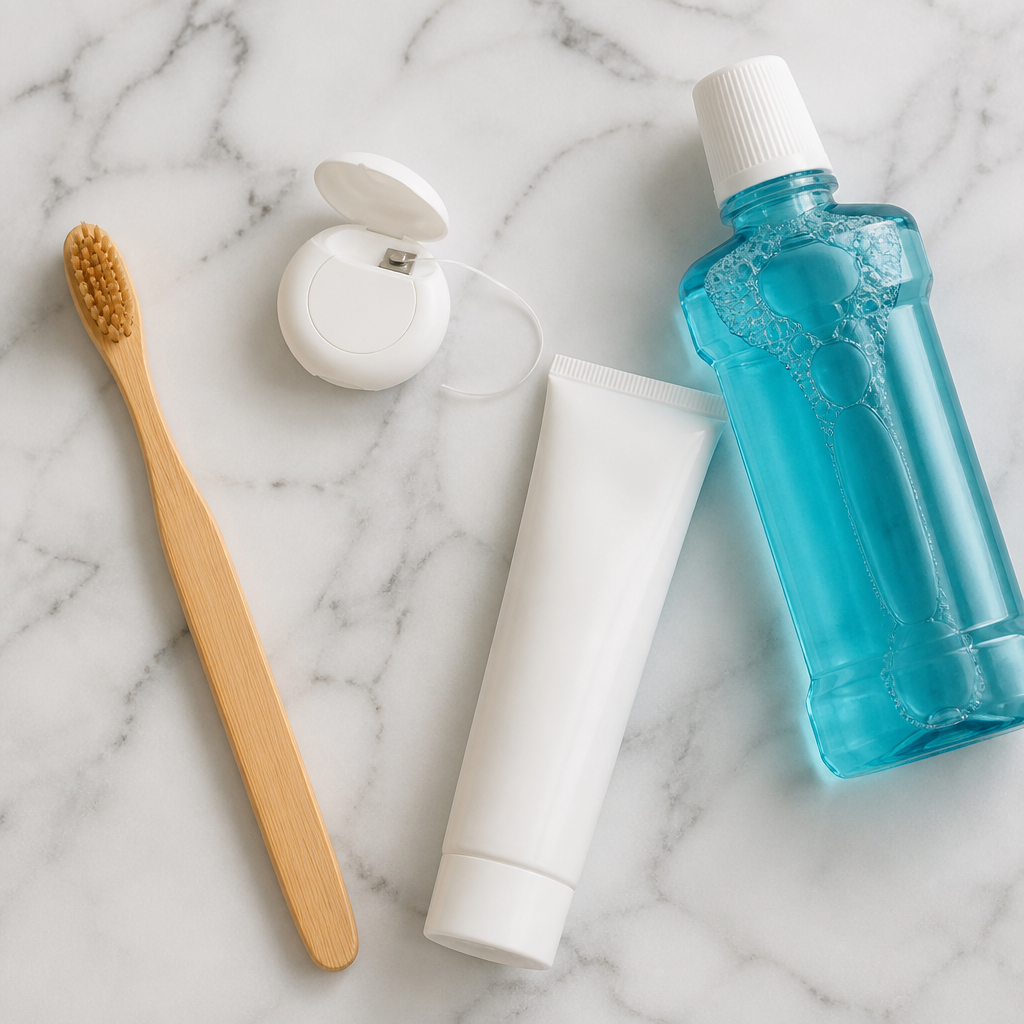
How to Brush and Floss Properly — A Dentist’s Guide
You have been brushing your teeth your entire life. But if you are like most of our patients, you are probably doing it too fast, pressing too hard, and missing the same spots every time.
This is not a criticism — it is what we see daily. Almost nobody was formally taught to brush properly. You watched your parents, figured it out as a kid, and never revisited the technique. The result is that most adults brush for about 45 seconds (the recommended time is two minutes) and miss significant portions of their teeth, particularly the inner surfaces and the gum line.
Here is how to do it properly.
Brushing Step by Step
Choose the Right Brush
- Soft bristles only. Medium and hard bristles abrade enamel and cause gum recession. There is no clinical reason to use anything firmer than soft.
- Small head. A smaller brush head reaches the back teeth more easily.
- Replace every 3 months, or sooner if the bristles are fraying. A worn brush cleans poorly and can harbour bacteria.
- Electric or manual — both work. But if you tend to brush too hard or too quickly, an electric toothbrush with a pressure sensor and timer (such as Oral-B iO or Philips Sonicare) takes the guesswork out.
The Modified Bass Technique
This is the technique most dentists recommend for adults:
- Angle the brush at 45 degrees toward the gum line. The tips of the bristles should be partly under the gum margin — this is where plaque accumulates most.
- Use gentle, short back-and-forth strokes (about one tooth wide) or small circular motions. Do not scrub. The motion should feel gentle, almost like a massage.
- Work systematically. Start on the outer surfaces of your upper teeth (left to right or right to left — just be consistent), then do the inner surfaces. Repeat for your lower teeth. Finish with the chewing surfaces.
- For the front teeth (inner surfaces), tilt the brush vertically and use up-and-down strokes with the toe of the brush.
- Brush your tongue from back to front. Your tongue is a major source of the bacteria that cause bad breath.
- Time yourself — two full minutes. Divide your mouth into four quadrants and spend 30 seconds on each. Most electric toothbrushes have built-in timers that pulse every 30 seconds.
Common Mistakes
- Too much pressure. If your bristles splay within a month, you are pressing too hard. Hold the brush with a light grip — like holding a pen, not a tennis racket.
- Same spots, same order. Most people start in the same place every time and rush toward the end. If you always start at the front, try starting at the back where the hardest-to-reach teeth are, while your concentration is highest.
- Missing the gum line. This is where plaque builds up. If you only brush the flat surfaces of your teeth, you are missing the most important area.
- Brushing right after eating. Acidic food and drink temporarily softens enamel. Brushing immediately can abrade the softened surface. Wait 30 minutes, or rinse with water immediately and brush later.
- Not brushing at night. This is the most important brush. Saliva production drops while you sleep, giving bacteria free rein. Skipping your night brush is far worse than skipping your morning brush.
Flossing Step by Step
Why Floss?
Your toothbrush — even an electric one — cannot reach between your teeth where they contact each other. These surfaces make up roughly 40 percent of your total tooth surface area. This is exactly where cavities most commonly develop in adults and where gum disease begins.
Traditional Floss Technique
- Cut about 30 centimetres of floss. Wind most of it around the middle finger of one hand, and a small amount around the middle finger of the other hand.
- Hold the floss taut between your thumbs and index fingers, with about 2 centimetres of floss between them.
- Guide the floss between teeth using a gentle back-and-forth sawing motion. Do not snap it down into the gum — this causes pain and damage.
- Curve the floss into a C-shape around one tooth. Slide it gently up and down against the side of the tooth, going just under the gum line.
- Repeat on the other side of the gap, curving around the adjacent tooth.
- Use a clean section of floss for each new gap.
- Do every gap — including behind your last tooth on each side.
Interdental Brushes (An Easier Alternative)
Many patients find interdental brushes (small, thin brushes that fit between teeth) easier and more comfortable than traditional floss. Research suggests they may actually be more effective than floss for most people.
How to use them:
- Choose the right size. They come in different diameters — the brush should fit snugly without forcing. You may need different sizes for different gaps.
- Insert gently between teeth and move back and forth a few times.
- No toothpaste needed.
- Rinse the brush and move to the next gap.
- Replace when the bristles wear (usually every 1 to 2 weeks).
Popular brands include Piksters (Australian) and TePe (Swedish). We stock them at the practice and can help you choose the right size.
Water Flossers
Water flossers (such as Waterpik) use a pressurised stream of water to flush out food particles and bacteria from between teeth and along the gum line. They are particularly useful for:
- Patients with braces, bridges, or implants where traditional floss is difficult
- People with dexterity issues (arthritis, limited hand mobility)
- Anyone who simply cannot maintain a flossing habit
They are not quite as effective as floss or interdental brushes at disrupting the bacterial film (biofilm) that causes gum disease, but they are significantly better than nothing. If the choice is between a water flosser you actually use and dental floss that stays in the drawer, go with the water flosser.
Children’s Brushing
For specific guidance on children’s dental care, see our children’s dentistry guide. Key points:
- Under 18 months: Clean gums with a damp cloth. Once teeth appear, use a small soft brush with a smear of low-fluoride toothpaste.
- 18 months to 6 years: Use a pea-sized amount of low-fluoride (children’s) toothpaste. An adult should brush for the child or closely supervise.
- 6 years and above: Switch to regular fluoride toothpaste. Supervise until you are confident they are brushing properly and spitting (not swallowing) the toothpaste.
- Flossing starts when two teeth touch each other (usually around age 2 to 3). An adult should do the flossing until the child has the dexterity to do it properly (around age 8 to 10).
Frequently Asked Questions
Should I brush before or after breakfast?
Either works, with a caveat. If you eat acidic foods for breakfast (citrus, juice, coffee), brushing immediately after can damage temporarily softened enamel. Either brush before breakfast or wait 30 minutes after eating. The night brush is far more important than the morning one.
How long should I brush for?
Two minutes. Most people underestimate how long two minutes is — try timing yourself. Divide your mouth into four quadrants and spend 30 seconds on each.
Is it normal for flossing to hurt?
Mild discomfort when you first start flossing is normal, especially if your gums are inflamed. This should improve within a week of daily flossing. If flossing consistently causes sharp pain or heavy bleeding after two weeks, see your dentist — there may be a cavity or other issue between the teeth.
Electric or manual toothbrush — which is better?
Both can be effective. However, electric toothbrushes (oscillating-rotating or sonic) consistently perform better in clinical studies, particularly for people who brush too hard, too fast, or inconsistently. If you are unsure about your manual technique, an electric brush is a good investment.
Want a personalised brushing and flossing review? We are happy to go through your technique at your next check-up — just ask.
Call us: (08) 8995 9530 Book online →


